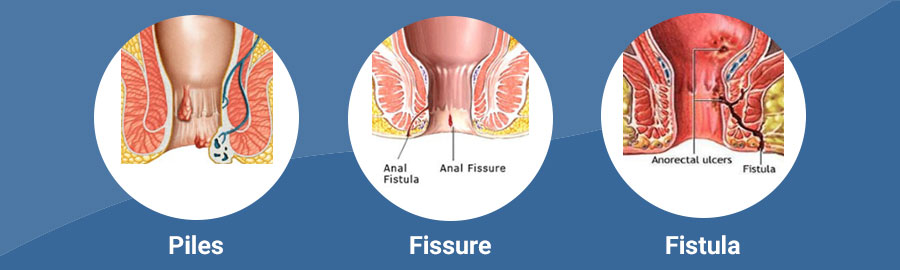
Piles, fissures and fistulas are the three commonest problems at the back passage (anus). Many people put up with them for years because they feel embarrassed to talk about them. All three are very treatable, but they are different conditions with different treatments, so it helps to know which one you may have. This guide explains how each one usually feels, what you can do at home and when you should see a surgeon.
Piles (haemorrhoids)
Piles are swollen blood vessels in and around the anus. Everyone has cushions of blood vessels there; they become piles when they swell, usually because of straining on the toilet.
- Bleeding: bright red blood on the toilet paper or in the pan after passing stool, usually without pain
- A lump: a soft swelling that comes out during a bowel movement and may go back on its own or need pushing back
- Other signs: itching, a feeling that the bowel has not emptied fully, and mucus or soiling
Piles are usually painless. Sudden severe pain with a hard, bluish lump at the edge of the anus usually means a small clot has formed in a pile, and it needs prompt assessment.
Anal fissure
A fissure is a small tear in the lining of the anus, usually caused by passing a hard or large stool.
- Pain: sharp, cutting or burning pain while passing stool, which can last from a few minutes to a few hours afterwards
- Bleeding: a small amount of bright red blood on the paper
- Fear of the toilet: many people start delaying bowel movements because of the pain, which makes the stool harder and the tear worse
The key difference from piles is pain. Piles mostly bleed; a fissure mostly hurts. A fissure that has lasted more than about six weeks is called a chronic fissure and is less likely to heal on its own.
Anal fistula
A fistula is a small tunnel between the inside of the anus and the skin nearby. It usually starts as an abscess, an infected gland next to the anus, that bursts or is drained.
- Discharge: pus, blood or fluid that keeps leaking from a small opening near the anus and stains underwear
- A recurring boil: a painful swelling next to the anus that bursts, settles and then comes back
- Irritation: itching and soreness of the skin around the opening
A painful, swollen area beside the anus with fever is an abscess. It needs to be drained promptly.
What you can do at home
Many piles and fissures, and the constipation behind them, improve with simple steps:
- Eat more fibre: vegetables, fruit, whole grains, dal and salads
- Drink enough water through the day
- Go to the toilet when you feel the urge, do not strain, and do not sit on the toilet for long (leave the phone outside)
- Sit in a tub of warm water for 10 to 15 minutes after a bowel movement (a sitz bath) to ease the pain and relax the muscle
- Use only the ointments and medicines your doctor prescribes
A fistula rarely heals with home care. It usually needs a procedure to close it.
When to see a surgeon
- Bleeding from the back passage that has not been checked before
- Bleeding after the age of 40, a change in bowel habit, weight loss, or a family history of bowel cancer
- Pain while passing stool that does not settle with home care
- A lump that keeps coming out or has to be pushed back
- Discharge, or a boil near the anus that keeps coming back
Go to the emergency department straight away if you have heavy bleeding or clots, feel dizzy or faint, have a painful swelling near the anus with fever, or have a pile that has come out, is very painful and cannot be pushed back.
Never assume that bleeding is from piles without an examination. Polyps, inflammation and bowel cancer can bleed in the same way, which is why a colonoscopy is advised for many patients.
What happens at the clinic
The surgeon asks about your symptoms and does a short, gentle examination in privacy. A small scope (proctoscope) may be used to look inside the anus. Most of the time this is enough to tell piles, fissure and fistula apart. If you are over 40, or have other symptoms or a family history, a colonoscopy may be advised. A complex or recurring fistula may need an MRI scan to map its track before surgery.
How each one is treated
- Piles: diet and ointments first; rubber-band ligation or injection in the clinic for internal piles that bleed or come out; surgery (haemorrhoidectomy, stapled procedure or laser) for larger or persistent piles
- Fissure: ointments that relax the anal muscle and help the tear heal; for a chronic fissure, a small operation (sphincterotomy) or other procedures
- Fistula: an abscess is drained first; the fistula is then treated by laying open the track, a seton (a soft thread), or muscle-preserving procedures including laser, chosen to cure the fistula while protecting bowel control
At our main hospital in Adajan, Surat, piles, fissure and fistula are treated by our colorectal and ano-rectal surgeon, Dr. Sanket Sherekar. Read more about piles, fissure and fistula and colorectal and ano-rectal surgery.