
ERCP in Surat What to Expect
ERCP (endoscopic retrograde cholangiopancreatography) treats problems of the bile duct and pancreatic duct through an endoscope passed via the mouth - removing stones, relieving blockages and placing stents - without any incision.
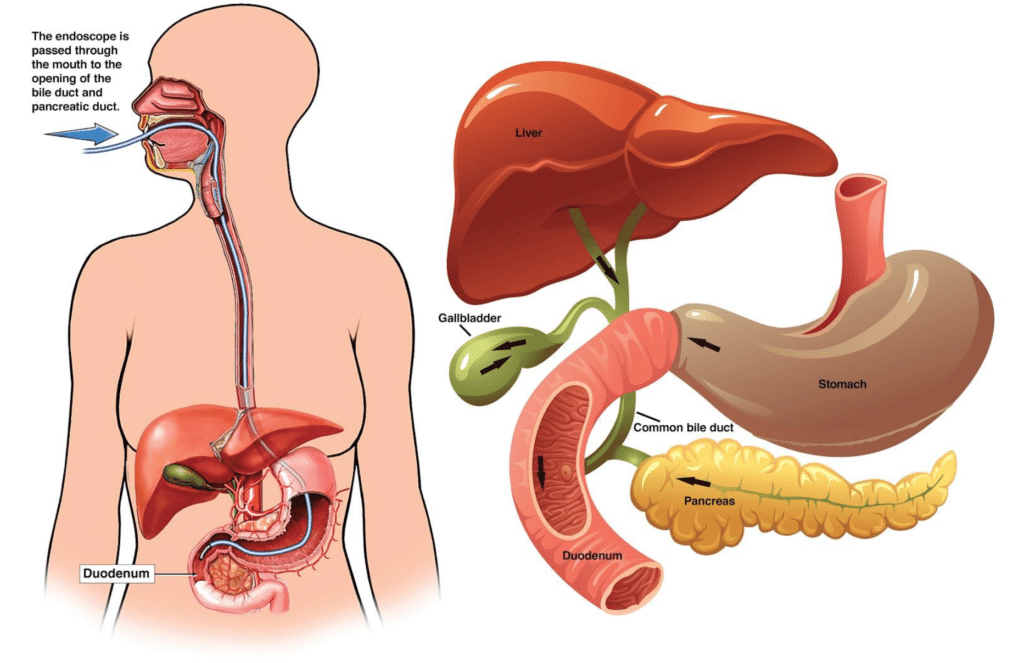
What is ERCP?
The endoscope is guided to the opening of the bile duct in the duodenum. A fine tube is passed into the duct, contrast dye and X-ray show the ducts, and instruments are used to remove stones, dilate narrowings, take samples or place stents. It is mainly a treatment rather than a diagnostic test, since MRCP and endoscopic ultrasound now provide the pictures without risk.
ERCP is performed by our medical gastroenterologists in the endoscopy suite under sedation or general anaesthesia, with X-ray guidance. For difficult stones and strictures, SpyGlass cholangioscopy is used alongside it.
When is ERCP Needed?
Your doctor may recommend it for:
- Stones in the bile duct causing pain, jaundice, infection or pancreatitis See: bile duct stones and blockage · acute pancreatitis
- Blockage of the bile duct by a stricture or tumour, to relieve jaundice with a stent See: obstructive jaundice · gallbladder and bile duct cancers
- Infection of the bile duct (cholangitis) - urgent drainage
- Bile leaks after gallbladder surgery
- Stones or strictures of the pancreatic duct in chronic pancreatitis
- Sampling of strictures to find the cause
ERCP is chosen when a duct problem needs treating, not just seeing - if only pictures are needed, MRCP or endoscopic ultrasound is used first.
Your ERCP Visit: Step by Step
ERCP is a treatment, so the visit is a little longer than a routine endoscopy. The procedure takes thirty to ninety minutes, and you are observed afterwards - often overnight.
- Before the day
Blood tests for clotting and kidney function are checked, and blood thinners are usually stopped for a few days as advised.
- Arrival and check-in
Check-in at the main hospital in Adajan; tell the team about any allergy, especially to contrast dye.
- Anaesthesia
Sedation or general anaesthesia is given, and your pulse, oxygen and blood pressure are monitored throughout.
- The procedure
Thirty to ninety minutes in the endoscopy suite with X-ray guidance (described in the next section).
- Observation and going home
You are observed for several hours, often overnight, to make sure there is no pancreatitis or bleeding. If a temporary stent was placed, you are given the date for its removal or exchange before you leave.
What Happens During ERCP
Sedation or general anaesthesia is given
The endoscope is passed to the duodenum and the duct opening is identified
A small cut (sphincterotomy) at the opening allows instruments to enter and stones to pass
Stones are pulled out with a balloon or basket; large stones may be crushed or fragmented under direct vision with SpyGlass
Narrowings are dilated and a plastic or metal stent is placed where needed
The procedure takes thirty to ninety minutes
What you will feel - and what you won't. Under sedation or general anaesthesia you feel nothing during the procedure and most patients remember none of it. Afterwards, mild abdominal discomfort and a sore throat are common for a day. There is no cut on the skin, so there is no wound to heal - the work is done entirely from inside the duct.
How to Prepare for ERCP
- Blood tests and blood thinners. Blood tests for clotting and kidney function are checked beforehand; blood thinners are usually stopped for a few days as advised.
- Allergies. Tell the team about allergies, particularly to contrast dye or iodine.
- Plan for a stay. Observation for several hours, often overnight, is usual - bring what you need for a night in hospital and someone to take you home.
These are general points. The written instructions you receive from the hospital for your own procedure take priority - see also Patient Information.
After ERCP: Recovery, Stents & Follow-up
The first hours. Observation in hospital for several hours, often overnight, to make sure there is no pancreatitis or bleeding. Nothing to eat for a few hours, then a light diet.
The next days. Mild abdominal discomfort and a sore throat are common. Severe abdominal pain, fever, vomiting or black stools must be reported immediately.
Stents and follow-up. If a temporary stent was placed, a date for its removal or exchange will be given - do not miss it. Your doctor explains the findings and the next step, including whether the gallbladder should be removed later.
Is ERCP Safe?
ERCP is more complex than a routine endoscopy and has specific risks. The commonest is pancreatitis, which is usually mild but occasionally serious; precautions are taken to reduce it.
Bleeding after sphincterotomy, infection, and, rarely, a perforation are the other main risks.
Your doctor weighs these against the benefit for you and explains them before consent.
Contact the hospital immediately if you develop severe abdominal pain, fever, vomiting or black stools after the procedure.
After a procedure, contact the hospital at once for severe pain, fever, vomiting, bleeding or breathlessness: Emergency 24×7: 90333 62020
Alternatives to ERCP
MRCP and endoscopic ultrasound provide the pictures of the ducts without the risks of ERCP, and are used first when only diagnosis is needed.
Drainage through the skin under imaging guidance is an alternative when the duct cannot be reached endoscopically.
Surgery for bile duct stones or strictures is used when ERCP is not possible or has failed.
Why Choose Gujarat Hospital for ERCP
ERCP is a treatment inside the bile duct, and its safety depends on the team, the imaging and what can be done when a stone or stricture proves difficult. At Gujarat Gastro & Vascular Hospital, Adajan, Surat:
- Done by consultant medical gastroenterologists with X-ray guidance in the endoscopy suite. Sedation or general anaesthesia with full monitoring, and a recovery area for observation afterwards.
- SpyGlass cholangioscopy in the same session. If a stone is too large or hard for balloons and baskets, or a stricture needs a direct look and biopsy, SpyGlass is used during the same ERCP - rather than a second referral elsewhere.
- Jaundice, stones and pancreatitis managed in one department. The same gastroenterologists who look after your liver, bile duct and pancreas plan the ERCP, so the findings go straight into your treatment.
Frequently Asked Questions about ERCP
Is ERCP an operation?
No. It is done through the mouth with an endoscope; there is no cut on the skin. Most patients stay one night for observation.
Will I be awake?
No. ERCP is done under sedation or general anaesthesia, chosen for you beforehand, so you feel nothing during the procedure and most patients remember none of it. You are monitored throughout.
Why can't the stone be left alone?
Duct stones cause jaundice, infection and pancreatitis, which can be dangerous. Clearing the duct removes those risks.
Why do I have to stay in hospital afterwards?
Because the specific risks of ERCP - pancreatitis and bleeding - show themselves in the first hours. Observation, often overnight, means any problem is caught and treated early. Most patients have no problem and go home the next day.
Will my gallbladder be removed as well?
If the stones came from the gallbladder, removing it afterwards is usually recommended to stop more stones passing into the duct.
Can ERCP be done if I am pregnant?
Yes, when the reason is urgent, such as a blocked or infected bile duct, because the risks of leaving it untreated are greater than those of the procedure. The X-ray dose is kept to a minimum and the abdomen is shielded. Where the procedure can safely wait until after delivery, it usually is; the gastroenterologist and obstetrician decide together.
What is a stent and will it stay forever?
A stent is a small plastic or metal tube that keeps the duct open and draining. Plastic stents are temporary and must be removed or exchanged on the date you are given; some metal stents are designed to stay. Your doctor tells you which you have and what the plan is.
Can I drive or work the day after ERCP?
Not on the same day. Sedation or anaesthesia affects judgement and reaction time for up to 24 hours, so someone must take you home and you should not drive, operate machinery or sign important documents. Most patients return to light work within a day or two once they are eating normally and free of pain.
The information on this page is for general patient education and does not replace individual medical advice, diagnosis or treatment. Medical Disclaimer