
Stroke and Carotid Artery Disease in Surat What to Expect
A stroke happens when the blood supply to part of the brain is cut off. Carotid artery disease - narrowing of the arteries in the neck that carry blood to the brain - is one of its major causes, and also causes mini-strokes (transient ischemic attacks). It can be treated with medicines, surgery to clear the artery or stenting, greatly reducing the risk of a stroke.
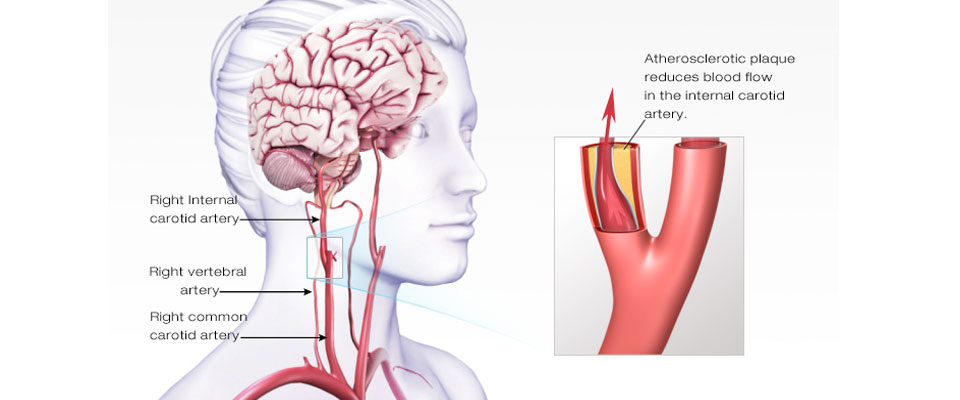
What Is Carotid Artery Disease and How Does It Cause a Stroke?
Most strokes are ischemic - a blocked artery starves part of the brain - and a smaller number are caused by bleeding into the brain. A stroke is a medical emergency: the sooner blood flow is restored, the more brain is saved. Think FAST - Face drooping, Arm weakness, Speech difficulty, Time to call emergency services. A mini-stroke (transient ischemic attack, TIA) causes the same symptoms but they clear within minutes to hours; it is a warning that a full stroke may follow within days and needs assessment just as urgently.
The two carotid arteries run up either side of the neck. Cholesterol plaque at the point where each divides can narrow the artery, and fragments of plaque or clot can break off and travel to the brain, causing a transient ischemic attack (mini-stroke) or a stroke. Many people have no symptoms until this happens; the narrowing may be found on a scan or by a whooshing sound (bruit) heard over the neck.
Treatment depends on how tight the narrowing is and whether it has already caused symptoms. Everyone needs medicines and risk-factor control. For a tight narrowing that has caused a mini-stroke, clearing the artery within two weeks (carotid endarterectomy) greatly reduces the risk of a full stroke; carotid stenting is an alternative in selected patients.
Being told after a mini-stroke or stroke that a neck artery is narrowed is worrying. The reassuring part is that the risk of another stroke can be lowered a great deal with the right treatment. The visit is about measuring the narrowing and deciding what protection you need.
Sometimes a narrowing is found without any symptoms, for example when a doctor hears a whooshing sound over the neck or a scan is done for another reason. Most of these are treated with medicines and repeat scans, and a procedure is considered in selected cases. Your surgeon will explain which applies to you.
Warning Signs of a Stroke or Mini-Stroke
Warning signs from the carotid arteries come on suddenly and are often brief. You may also notice:
- Often none until a mini-stroke or stroke occurs
- Sudden weakness or numbness of the face, arm or leg on one side
- Sudden difficulty speaking or understanding speech
- Sudden loss of vision in one eye, like a curtain coming down (amaurosis fugax)
- Symptoms lasting minutes to hours and then resolving completely (transient ischemic attack)
- Sudden clumsiness of one hand, or dropping things without meaning to
- Slurred speech or trouble finding words, even for a few minutes
- Tingling or numbness of one side of the face or one hand that passes off
Symptoms vary from person to person. Having one or more of these does not confirm the condition - it means it is worth being checked.
When Is It an Emergency?
Do not wait for an online appointment if you have any of the following. Call the hospital or go to the nearest emergency department.
- Any sudden weakness, numbness, speech difficulty or loss of vision - call emergency services immediately, even if it resolves
- A mini-stroke in the last two weeks - the risk of a full stroke is highest now
How We Check the Carotid Arteries
At your visit the doctor asks exactly what happened and when, reviews any brain scan and discharge reports, checks your blood pressure and pulse, and listens over your neck. A carotid duplex ultrasound is done by the vascular team at the hospital. Further imaging is added if a procedure is being considered.
What Narrows the Carotid Arteries?
- Atherosclerosis at the carotid bifurcation
- Smoking, high blood pressure, high cholesterol and diabetes
- Increasing age and family history
- Previous radiotherapy to the neck (less common)
Plaque builds up slowly over many years, by the same process that narrows the heart and leg arteries. People with carotid disease often have narrowing elsewhere too, so controlling the risk factors protects the whole body. Not every stroke comes from the carotid arteries - an irregular heartbeat or bleeding in the brain are other causes - so the scan is one part of finding the cause.
Investigations
- Carotid duplex ultrasound
- Painless scan that measures how narrow the artery is and what the plaque looks like.What to expect: A painless scan done at the hospital by the vascular team. You lie on your back with your head turned slightly, and gel and a probe are moved along each side of your neck. There is no needle or radiation.
- CT or MR angiography
- Confirms the degree of narrowing and shows the arteries inside the head when a procedure is planned.What to expect: Needed mainly when a procedure is being considered. For CT a dye is given through a drip; MRI is noisy but painless and you lie still in the scanner. Your doctor will tell you where it is done and how to prepare.
- Brain imaging
- CT or MRI after any stroke or mini-stroke.What to expect: Usually done at the hospital that treated your stroke or mini-stroke. Bring the reports and images to your visit so the surgeon can see which side of the brain was affected.
- Heart and risk-factor assessment
- ECG, blood pressure, cholesterol and diabetes checks.What to expect: An ECG with stickers on your chest, a blood pressure check and blood tests for cholesterol, sugar and kidney function. Your doctor may also advise a heart rhythm check, as an irregular heartbeat can cause strokes too.
Treatment Options for Carotid Artery Disease
The usual path
- Emergency care for a stroke happening now.
Call an ambulance or go to the nearest hospital with emergency stroke care at once. Treatment of the carotid narrowing is planned afterwards.
- Medicines and risk-factor control.
Antiplatelet medicine, a statin, blood pressure and diabetes control and stopping smoking - started early and continued long-term.
- Measure the narrowing.
A carotid duplex ultrasound shows how tight the narrowing is. Angiography is added if a procedure is being considered.
- Endarterectomy or stenting if advised.
For a tight narrowing that has caused symptoms, the vascular surgeon explains whether an operation to clear the artery or a stent is advised, how soon, and how it would be arranged.
- Best medical treatment
- Antiplatelet medicine, a high-intensity statin, blood-pressure and diabetes control and stopping smoking - for every patient.
- Emergency stroke care
- A stroke that is happening now needs emergency treatment in a hospital with CT scanning and stroke care - clot-dissolving medicine or clot retrieval may be possible in the first hours. Treatment of the carotid narrowing follows, to prevent a second stroke.
- Carotid endarterectomy
- An operation through a small incision in the neck to remove the plaque, recommended for a tight narrowing that has caused symptoms, ideally within two weeks.
- Carotid stenting
- A stent placed through a puncture in the groin or neck, used when surgery is higher risk, for example after neck radiotherapy or previous neck surgery.
- Surveillance
- Regular ultrasound for moderate, symptom-free narrowing to watch for progression.
The right treatment depends on the cause, how severe it is and your overall health. Your doctor will discuss the options with you before anything is decided.
Frequently Asked Questions about Stroke and Carotid Artery Disease
What is the difference between a stroke and a mini-stroke?
Both are caused by a blocked artery in the brain. In a mini-stroke (TIA) the blockage clears on its own and the symptoms resolve within 24 hours, usually much sooner; in a stroke the damage persists. Both need the same urgent assessment, because a TIA is often followed by a stroke within days.
My mini-stroke symptoms went away - do I still need treatment?
Yes, urgently. A transient ischemic attack is a warning that a full stroke may follow within days. Assessment and, if indicated, surgery within two weeks gives the greatest protection.
Is the operation risky?
Carotid endarterectomy carries a small risk of stroke during or after surgery, which is why it is offered only when the risk of stroke without it is clearly higher. Your surgeon will discuss the figures for your situation.
Can the narrowing go away with medicines?
Medicines stabilise the plaque and reduce the risk of clots, but rarely reverse the narrowing. For tight, symptomatic narrowing a procedure is still needed.
What should I do if I have a stroke or mini-stroke symptom at home?
Note the time it started and call emergency services or go to the nearest hospital with a CT scanner at once - do not wait to see whether it passes, and do not drive yourself. Do not give the person food, drink or tablets, as swallowing may be affected. Clot-dissolving treatment works only in the first few hours, so every minute counts.
When can I drive and return to work after carotid surgery?
Most people are home within a day or two and can walk and do light activity straight away. Driving is usually possible after about two weeks if you have recovered fully and your doctor has cleared you; after a stroke or mini-stroke there may be additional rules on when you may drive. Desk work can often resume in two to three weeks, heavier work a little later, and the neck wound should be kept clean and dry until healed.
Which doctor should I see about a narrowed neck artery?
A vascular surgeon, who assesses the carotid arteries and advises on treatment. If you have had a stroke, keep seeing the doctors who treated it as well. You can book at our Adajan hospital or at the OPD nearest you; the duplex scan is done at Adajan.
Should I have my neck arteries checked if I have no symptoms?
Routine scans for everyone are not usually advised. Your doctor may suggest a duplex scan if a whooshing sound is heard over the neck, if you have narrowed arteries elsewhere, or if you have several risk factors.
Should I stop my blood-thinning tablets before the duplex scan?
No. The scan is painless and needs no preparation, so keep taking your medicines as usual. Never stop aspirin or other blood thinners on your own; ask your doctor first.
Why Choose Gujarat Hospital for Carotid Artery Disease
How we look after stroke and carotid artery disease at our main hospital in Adajan, Surat:
- A stroke happening now needs emergency care. Call an ambulance or go to the nearest hospital with emergency stroke care at once. Our role is the carotid assessment and prevention that follow.
- Carotid duplex ultrasound by the vascular team, a painless scan done at the hospital that shows how narrow each neck artery is and what the plaque looks like.
- A vascular surgeon reviews your case. Dr. Ankur Patel, Vascular & Endovascular Surgeon, looks at your scans and reports and explains whether endarterectomy or stenting is advised, or whether medicines and regular scans are enough.
- Medicines and risk-factor control for everyone, with antiplatelet medicine, a statin, blood pressure and diabetes control and help to stop smoking, and follow-up scans where needed.
The information on this page is for general patient education and does not replace individual medical advice, diagnosis or treatment. Medical Disclaimer