
Hernia in Surat What to Expect
A hernia is a bulge where the intestine or fat pushes through a weak spot in the abdominal wall - most often in the groin (inguinal), at the navel (umbilical) or through an old scar (incisional). Hernias do not heal on their own; repair is a common, safe operation. Hernia surgery in Surat is usually done laparoscopically or robotically at our Adajan hospital.
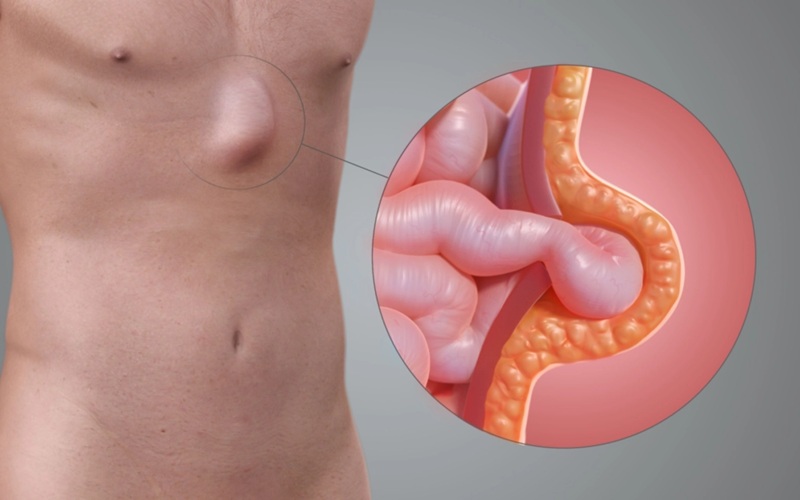
What Is a Hernia?
Hernias enlarge slowly over time. They are usually painless or cause a dragging ache, but a hernia that becomes trapped (incarcerated) and loses its blood supply (strangulated) is an emergency. Repair is advised for most symptomatic hernias and for many that are still small, to prevent that complication.
Modern repair places a mesh to reinforce the weak area and is usually done laparoscopically or robotically, with less pain and a quicker return to activity than open surgery. Our surgical team performs all three approaches and chooses with you according to the type of hernia, previous surgery and your health. See Dr. Gabani's video on the types of hernia.
Hernias are very common, especially in men, and many people live with a small lump for months or years before having it checked. A hernia will not go away by itself, but in most cases there is time to plan the repair calmly rather than as an emergency.
At your visit the surgeon examines the lump while you stand and lie down, asks how much it bothers you and checks your general health. Together you decide whether to repair it now and which approach suits you - keyhole, robotic or open.
Types of Hernia
- Inguinal hernia
- In the groin - the commonest type, especially in men. It may extend into the scrotum.
- Femoral hernia
- Just below the groin crease, more common in women. It is more likely to become trapped, so repair is usually advised soon.
- Umbilical and paraumbilical hernia
- At or just above the navel; common after pregnancy and with extra weight around the abdomen.
- Incisional hernia
- Through the scar of an earlier abdominal operation, sometimes years later.
- Epigastric hernia
- A small lump in the midline of the upper abdomen, between the navel and the breastbone.
- Hiatus hernia
- Part of the stomach slides up through the diaphragm into the chest. It causes heartburn and reflux rather than a lump; many people are treated with medicines, and surgery is for selected patients.
- Recurrent hernia
- A hernia that comes back after an earlier repair. It is assessed carefully and is often repaired by a different approach from the first operation.
Symptoms of a Hernia
A hernia can be obvious or easy to miss. You may notice:
- A lump or bulge in the groin, around the navel or over a scar, more obvious on standing, coughing or straining
- A dragging or aching discomfort, worse at the end of the day
- The lump may disappear on lying down
- In some men, a swelling extending into the scrotum
- Sudden severe pain, a hard tender lump, vomiting - signs of a trapped hernia
- A heavy or full feeling in the groin, especially after standing for a long time
- Discomfort when lifting, coughing or bending
- A bulge near an old operation scar that grows over months
Symptoms vary from person to person. Having one or more of these does not confirm the condition - it means it is worth being checked.
When Is a Hernia an Emergency?
Do not wait for an online appointment if you have any of the following. Call the hospital or go to the nearest emergency department.
- A hernia that suddenly becomes painful, hard and cannot be pushed back
- Vomiting, abdominal swelling or inability to pass wind with a painful hernia
- Redness or discolouration of the skin over the hernia
How We Diagnose a Hernia
At your consultation the surgeon asks when you noticed the lump and whether it causes pain, and examines you standing and lying down, sometimes asking you to cough. Most hernias need no tests beyond this. A scan is arranged when the diagnosis is unclear or when a large or repeat hernia needs planning.
What Causes a Hernia?
- A natural weak point in the abdominal wall, present from birth or developing with age
- Heavy lifting, chronic cough, constipation and straining
- Previous abdominal surgery (incisional hernia)
- Obesity, pregnancy, smoking
- Conditions that weaken tissues
Most hernias come from a weak spot that has been there for years, with everyday strain gradually pushing tissue through it. Things that raise pressure inside the abdomen - heavy lifting, a long-standing cough, straining with constipation or carrying extra weight - make a hernia more likely and can make it grow. Treating these also lowers the chance of a hernia returning after repair.
Investigations
- Clinical examination
- Most hernias are diagnosed by examination alone.What to expect: A short examination in the clinic, standing and lying down, while the surgeon feels the area as you cough. It is painless.
- Ultrasound
- When the diagnosis is unclear or the hernia is small.What to expect: Gel is spread on the skin and a probe is moved over the area while you stand or lie down. It is painless and uses no radiation.
- CT scan
- For complex or recurrent hernias and for planning repair of large incisional hernias.What to expect: You lie on a table that moves through a ring-shaped scanner. Sometimes a dye is injected or given as a drink to make the pictures clearer. It is painless and quick.
Treatment Options for a Hernia
The usual path
- Confirm the hernia.
Examination, and a scan when needed, shows the type and size of the hernia.
- Watch and wait for some.
A small hernia that causes no symptoms may be observed in some patients, with clear advice on warning signs.
- Planned repair.
For most people the hernia is repaired with mesh, by keyhole, robotic or open surgery, chosen for your hernia and your health.
- Emergency surgery if trapped.
A hernia that becomes hard, painful and will not go back needs urgent surgery to protect the bowel.
Surgery
- Laparoscopic repair
- Keyhole placement of mesh behind the abdominal wall; the usual choice for groin hernias, especially when both sides or a recurrence are involved.
- Robotic repair
- The same principle using the robotic system, offered for suitable patients.
- Open mesh repair
- Through an incision over the hernia; a good option for some groin and umbilical hernias and where keyhole surgery is not suitable.
- Complex abdominal wall reconstruction
- For large incisional hernias, planned repair with mesh and sometimes techniques that release the abdominal muscles.
Other care
- Watchful waiting
- Some small, painless hernias in older or unfit patients can be observed, with clear advice on warning signs.
Surgical Techniques: Laparoscopic, Robotic and Open Repair
- Laparoscopic TEP repair
- Totally extraperitoneal repair: the mesh is placed through three small cuts in the layer between the abdominal muscles and the lining of the abdomen, without entering the abdominal cavity. Used for groin hernias, including hernias on both sides.
- Laparoscopic TAPP repair
- Transabdominal preperitoneal repair: the surgeon works from inside the abdomen, opens the lining over the hernia, places the mesh and closes the lining over it. Useful for recurrent and both-sided groin hernias.
- Laparoscopic ventral and incisional hernia repair
- For hernias at the navel, in the midline or through a scar: the gap in the muscle is closed where possible and a mesh is placed across it, through small cuts.
- Robotic hernia repair
- The same mesh repair done with robotic instruments that the surgeon controls from a console. The steady, precise instruments help with stitching in tight spaces, and it is offered for suitable groin, ventral and incisional hernias.
- Open mesh repair
- Through one cut over the hernia, the bulge is pushed back and a mesh is stitched in place to strengthen the wall. It can be done under spinal or local anaesthesia, which suits some patients who should avoid a general anaesthetic.
- Hiatus hernia repair
- Done by keyhole surgery: the stomach is brought back into the abdomen, the opening in the diaphragm is narrowed and the top of the stomach is usually wrapped around the lower food pipe (fundoplication) to stop reflux.
Your surgeon explains which technique suits your hernia, your health and any previous operations before a decision is made.
The right treatment depends on the cause, how severe it is and your overall health. Your doctor will discuss the options with you before anything is decided.
Frequently Asked Questions about Hernia Repair
Can a hernia be treated without surgery?
No. A truss or belt only hides it. Surgery is the only repair; the decision is about when, not whether, for most patients.
How soon can I return to work?
After keyhole repair many people are back to light work within a week and to heavy work in a few weeks. Your surgeon will give specific advice.
Will the hernia come back?
Recurrence after mesh repair is uncommon. Avoiding heavy lifting during healing, treating constipation and stopping smoking reduce the risk.
How do I know if my hernia has become trapped?
A hernia that was soft and used to go back on lying down becomes hard, tender and will not push back in. There may be sudden severe pain, vomiting, abdominal swelling or inability to pass wind, and the skin over the lump may look red or dark. This is an emergency - do not wait for the pain to settle, come to the hospital at once.
Can hernias on both sides be repaired in one operation?
Yes. Keyhole repair is particularly suited to groin hernias on both sides, because both can be treated through the same small incisions in a single sitting, with one anaesthetic and one recovery period. The surgeon will confirm this is suitable after examining you and reviewing your general health.
Which doctor should I see for a hernia?
A general or GI surgeon. You can book a consultation at our Adajan hospital or at the OPD nearest you; the operation itself is done at Adajan.
What kind of anaesthesia is used for hernia repair?
Keyhole and robotic repairs are done under general anaesthesia. Some open repairs can be done under spinal or local anaesthesia. The anaesthetist and surgeon discuss the choice with you before the operation.
Can I keep working and lifting while I wait for surgery?
Most people carry on with normal daily life. It is sensible to avoid heavy lifting and straining, and to treat constipation or a long-standing cough. If the lump becomes painful, hard or will not go back, come to the hospital straight away.
Why Choose Gujarat Hospital for Hernia Repair
How we look after a hernia at our main hospital in Adajan, Surat:
- All three approaches at one hospital. Keyhole (laparoscopic), robotic and open mesh repair are all performed here, so the method is chosen for your hernia rather than the other way round.
- Robotic repair, offered for suitable patients.
- Planning for large and repeat hernias. Incisional and recurrent hernias are assessed carefully, and complex abdominal wall repair is planned in advance.
The information on this page is for general patient education and does not replace individual medical advice, diagnosis or treatment. Medical Disclaimer