
Gallbladder and Bile Duct Cancers in Surat What to Expect
Cancers of the gallbladder and bile ducts are uncommon but are seen more often in parts of India. They may be found by chance after gallbladder surgery or present with jaundice. Early tumours can be removed surgically; others are treated with drainage, chemotherapy and supportive care.
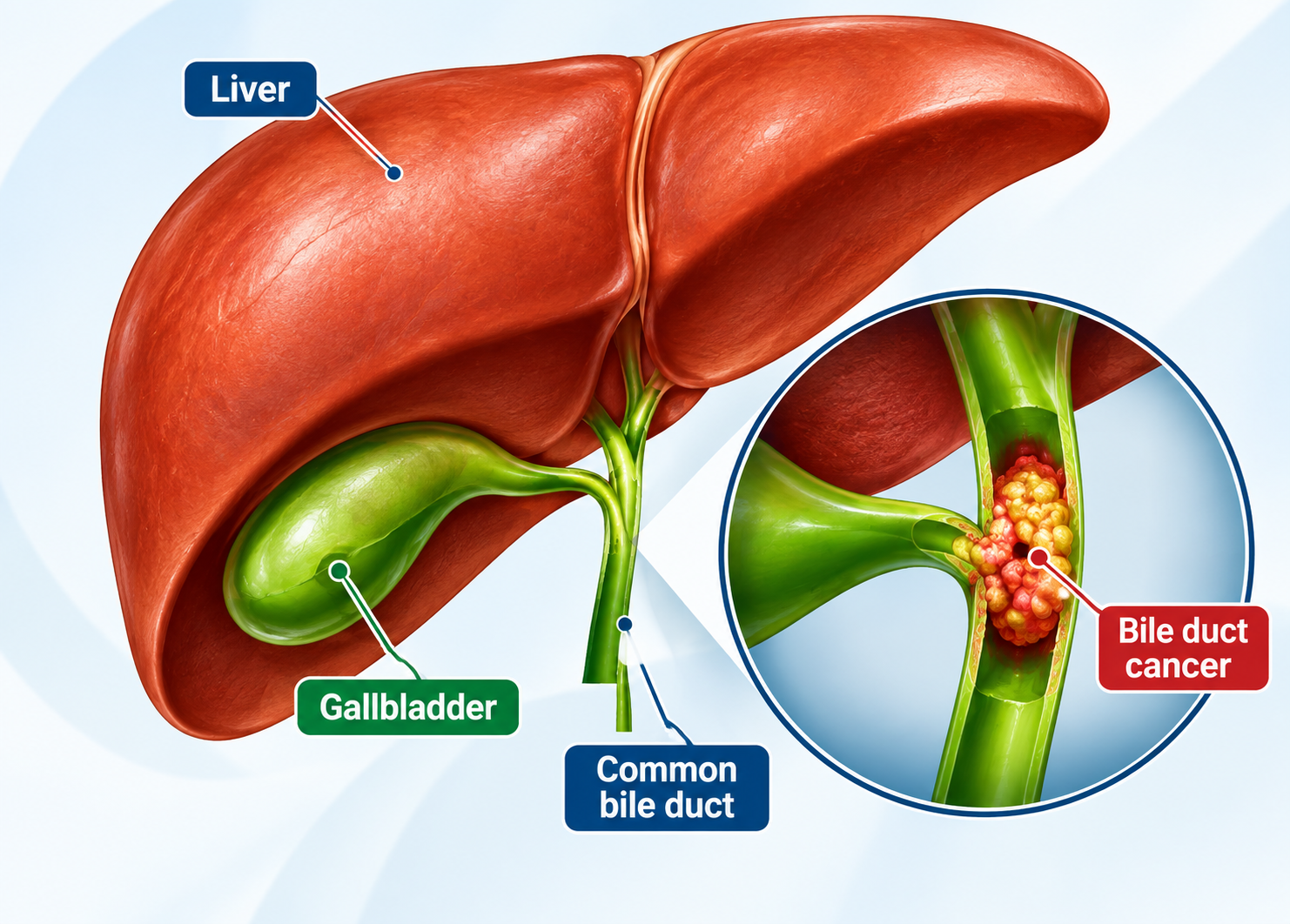
What Are Gallbladder and Bile Duct Cancers?
Gallbladder cancer is linked to long-standing gallstones and is sometimes discovered only when the removed gallbladder is examined. Bile duct cancer (cholangiocarcinoma) usually presents with painless jaundice. Both need accurate staging before treatment is planned, because surgery is only beneficial when the tumour can be completely removed.
Our surgical gastroenterologists perform major hepatobiliary operations, our medical gastroenterologists provide endoscopic drainage and biopsy, and treatment is planned together with oncology. The aims are always discussed openly with patients and families: cure where possible, and relief of symptoms with the best possible quality of life where it is not.
Hearing that you may have a cancer of the gallbladder or bile duct is frightening, for you and your family. It helps to know that each step - tests, staging and the treatment plan - will be explained, and that you will have time to ask questions before anything is decided.
Treatment depends on the stage. When the tumour can be removed completely, surgery offers the chance of cure. When it cannot, there is still a great deal that can be done: relieving jaundice, controlling pain and keeping you eating and active are all part of good care.
Symptoms of Gallbladder and Bile Duct Cancer
These cancers often cause few symptoms early on. Signs that may appear include:
- Jaundice, dark urine, pale stools and itching
- Pain under the right ribs
- Loss of appetite and weight
- A lump in the upper abdomen
- Fever, if the duct becomes infected
- Sometimes no symptoms - found incidentally
- Feeling full quickly or losing interest in food
- Tiredness and weakness that do not improve with rest
Symptoms vary from person to person. Having one or more of these does not confirm the condition - it means it is worth being checked.
When Should You Seek Urgent Care?
Do not wait for an online appointment if you have any of the following. Call the hospital or go to the nearest emergency department.
- Fever and shivering with jaundice
- Confusion or bleeding
- Inability to eat or drink
How We Diagnose and Stage These Cancers
At your first visit the doctor reviews your symptoms and any reports you bring, and examines you. Imaging comes first to define the tumour. EUS and ERCP with SpyGlass allow biopsies and, if needed, drainage. Staging then shows whether surgery can remove the tumour completely.
Who Is at Risk of Gallbladder and Bile Duct Cancer?
- Long-standing gallstones and chronic inflammation of the gallbladder
- Primary sclerosing cholangitis and other chronic bile-duct diseases
- Choledochal cysts and some parasitic infections
- Increasing age; regional and familial factors
Most people with gallstones never develop gallbladder cancer, but long-standing stones and chronic inflammation do raise the risk. Bile duct cancer is linked to long-term bile duct diseases and choledochal cysts. In many patients no clear cause is found, and it is not the result of anything they did or failed to do.
Investigations
- Imaging
- Ultrasound, then multiphase CT and MRI/MRCP to define the tumour and its relation to blood vessels.What to expect: Ultrasound is a painless scan with a probe on your abdomen. For CT you may be given a dye through a drip; MRI and MRCP are noisy but painless, and you lie still in the scanner.
- Endoscopic ultrasound and ERCP with SpyGlass
- Close-up imaging and targeted biopsies of the duct; drainage at the same time.What to expect: Done under sedation with monitoring, through the mouth, with no cut. Samples are taken and a stent can be placed in the same procedure; biopsy results follow later.
- Blood tests and tumour markers
- CA 19-9 and liver function.What to expect: A routine blood sample. Tumour markers are one piece of the picture and are read together with the scans, not on their own.
- Staging
- Chest and abdominal scans and, where needed, a diagnostic laparoscopy to check for spread before major surgery.What to expect: Usually more scans. If a diagnostic laparoscopy is advised, it is done under general anaesthetic through small cuts, and your surgeon explains why it is needed.
Treatment Options for Gallbladder and Bile Duct Cancers
The usual path
- Relieve jaundice and symptoms.
If the bile duct is blocked, a stent is placed to drain bile, ease itching and let the liver recover.
- Confirm the diagnosis and stage.
Biopsies and scans show the type of tumour and how far it has spread, so the right treatment can be chosen.
- Surgery when the tumour can be removed.
Our surgeons remove the tumour with the surrounding tissue and lymph nodes, sometimes with part of the liver or pancreas.
- Further treatment and support.
Chemotherapy may be advised after surgery or instead of it; your doctor will explain the plan and where it is given. Pain relief, nutrition and symptom care continue at every stage.
Endoscopic treatment
- Biliary drainage
- Stents placed by ERCP or through the skin relieve jaundice and itching whether or not surgery is planned.
Surgery
- Surgery
- Removal of the gallbladder with part of the liver and lymph nodes for gallbladder cancer; bile duct resection, sometimes with liver resection or a Whipple's operation, for duct cancers - when the tumour can be removed completely.
Other care
- Chemotherapy and other therapies
- Given after surgery to reduce recurrence, or as the main treatment when surgery is not possible, planned with oncology.
- Supportive and palliative care
- Pain relief, nutrition and symptom control are part of treatment at every stage.
The right treatment depends on the cause, how severe it is and your overall health. Your doctor will discuss the options with you before anything is decided.
Frequently Asked Questions about Gallbladder and Bile Duct Cancers
My gallbladder was removed for stones and the report shows cancer - what now?
This happens occasionally. Depending on how deep the tumour is, a second operation to remove part of the liver and lymph nodes may be recommended. Please bring the pathology report for review.
Can bile duct cancer be cured?
When it is found early and can be completely removed, yes for some patients. Many are found later; for them, treatment focuses on controlling the disease and relieving symptoms.
Is there a screening test?
Not for the general population. People with primary sclerosing cholangitis or choledochal cysts are monitored by their specialist.
Why does the jaundice need to be relieved before surgery or chemotherapy?
When bile cannot drain, it builds up in the blood and causes itching, poor appetite, weakened clotting and a risk of duct infection. Draining the bile with a stent placed by ERCP or through the skin lets the liver recover, which makes major surgery safer and allows chemotherapy to be given. Drainage also relieves symptoms in patients for whom surgery is not planned.
I have gallstones - should I have my gallbladder removed to prevent cancer?
Not usually. Gallbladder cancer is uncommon even though it is linked to long-standing stones, and silent stones found by chance do not need removal just to prevent it. Surgery is advised when stones cause symptoms, when the gallbladder wall looks abnormal or calcified on a scan, or when a polyp is present above a certain size. Your doctor will decide after reviewing your scan.
Is a biopsy always needed before surgery?
Not always. When scans strongly suggest a tumour that can be removed completely, surgeons may advise operating without a biopsy first. A biopsy is usually needed before chemotherapy or when the diagnosis is unclear.
What does staging mean?
Staging means finding out how large the tumour is and whether it has spread to lymph nodes, blood vessels or other organs. It decides whether surgery can help and which treatment is right for you.
What should I bring to my appointment?
All scan reports and images, biopsy and blood reports, any discharge summaries and a list of your medicines. It helps to bring a family member, as there is a lot to discuss.
Why Choose Gujarat Hospital for Gallbladder and Bile Duct Cancers
How we look after gallbladder and bile duct cancers at our main hospital in Adajan, Surat:
- Surgeons with special interest in cancer surgery, including operations on the gallbladder, bile duct, liver and pancreas.
- Diagnosis and drainage through the endoscope. EUS, ERCP and SpyGlass cholangioscopy allow targeted biopsies and stent placement in our endoscopy suite.
- Your treatment is planned together. Medical and surgical gastroenterologists on the same campus review the scans and biopsy results together before advising you.
- Honest discussion of the aims of treatment, with you and your family, whether the goal is cure or relief of symptoms.
The information on this page is for general patient education and does not replace individual medical advice, diagnosis or treatment. Medical Disclaimer