
Obstructive Jaundice in Surat What to Expect
Obstructive jaundice is yellowing caused by a blocked bile duct rather than a sick liver. The commonest causes are a stone and a tumour of the pancreas or bile duct. Finding the cause quickly matters, because the treatment is very different for each.
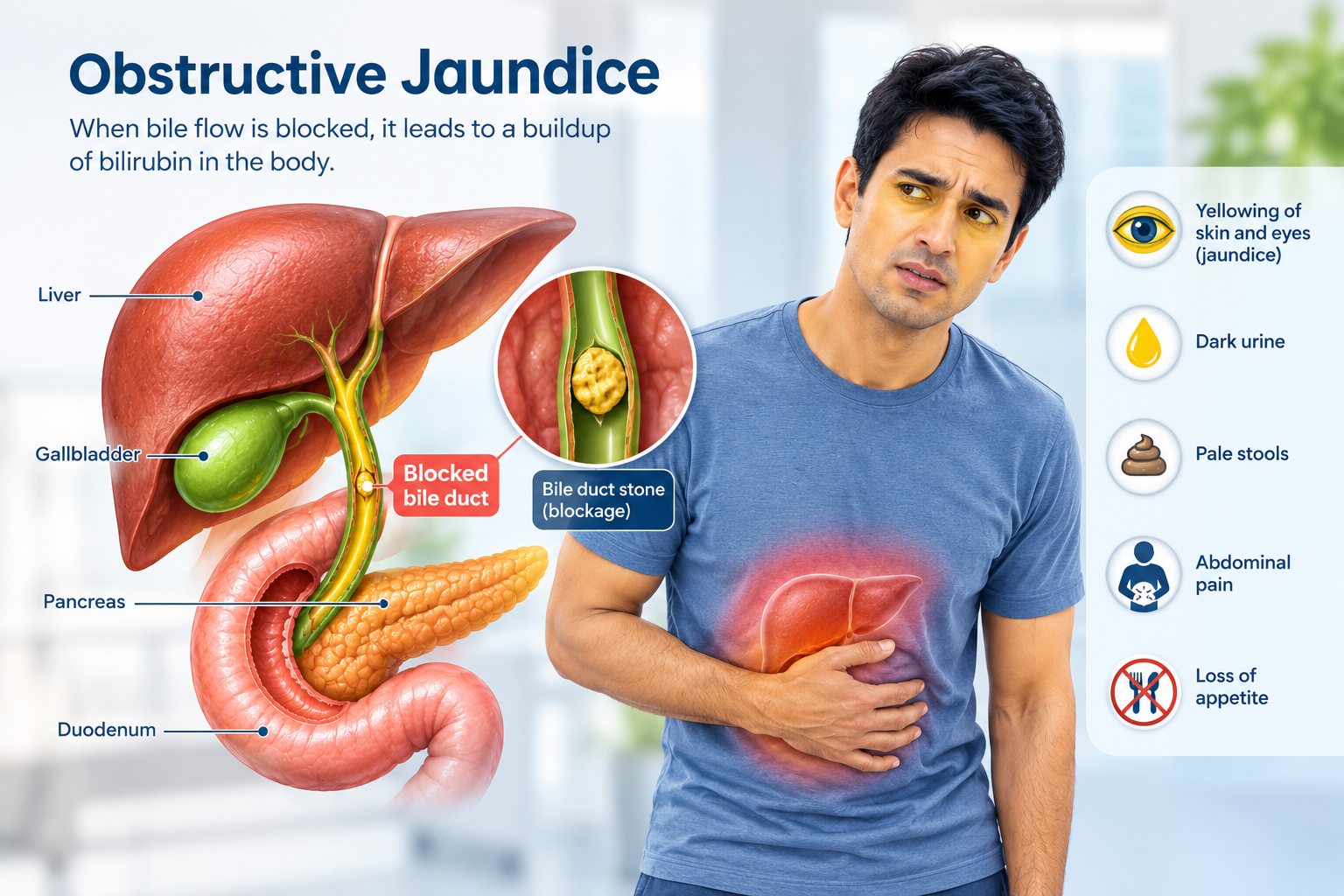
What Is Obstructive Jaundice?
When bile cannot drain, bilirubin backs up into the blood. The tell-tale features are pale stools, dark urine and itching, and blood tests show a characteristic pattern. Ultrasound confirms that the ducts are dilated; further imaging then shows where and why. Painless, progressive jaundice with weight loss raises concern about a tumour; jaundice with pain and fever points to a stone.
Relieving the obstruction - endoscopically, radiologically or surgically - protects the liver, treats infection and, in the case of tumours, is often the first step in a treatment plan made jointly by our gastroenterologists and surgeons.
Noticing yellow eyes is worrying, and it is right to see a doctor promptly. Obstructive jaundice means bile cannot drain because something is blocking the duct. Once the cause is found, the blockage can usually be relieved, and the jaundice and itching then fade gradually.
The first step is to work out where the blockage is and what is causing it. A stone is the most common reason and is often cleared during the same procedure that relieves the jaundice. If a growth is found, draining the bile is still the first step while further treatment is planned.
Signs of a Blocked Bile Duct
Obstructive jaundice usually shows itself through changes you can see. You may also notice:
- Yellow eyes and skin that deepens over days
- Dark urine and pale or clay-coloured stools
- Itching, often troublesome
- Pain under the right ribs or in the back (stones, pancreatic causes)
- Weight loss and loss of appetite (more typical of tumours)
- Fever and shivering if the blocked duct becomes infected
- Itching that is worse at night and keeps you awake
- Feeling weak and tired, with little appetite
Symptoms vary from person to person. Having one or more of these does not confirm the condition - it means it is worth being checked.
When Should You See a Doctor Urgently for Jaundice?
Do not wait for an online appointment if you have any of the following. Call the hospital or go to the nearest emergency department.
- Fever with jaundice - possible cholangitis
- Confusion, bleeding or very dark urine with little output
- Jaundice that is deepening rapidly
How We Find the Cause of the Blockage
At your first visit the doctor asks how the jaundice started, about pain, fever, weight loss and medicines, and examines you. Blood tests and an ultrasound come first and confirm a blockage. Further scans and, where needed, a biopsy then show the cause, so that drainage and treatment can be planned.
What Blocks the Bile Duct?
- Gallstones in the bile duct
- Cancer of the head of the pancreas, the bile duct (cholangiocarcinoma), the ampulla or the gallbladder
- Benign strictures after surgery or from chronic pancreatitis
- Enlarged lymph nodes or cysts pressing on the duct
- Parasites, in some regions
In practice, the two most common causes are a stone in the bile duct and a tumour of the pancreas or bile duct. Pain and fever point more towards a stone; slowly deepening jaundice without pain, especially with weight loss, needs prompt tests to rule out a tumour. Benign narrowings are less common.
Investigations
- Blood tests
- Confirm the obstructive pattern and check clotting, which is affected by prolonged obstruction.What to expect: A routine blood sample. Clotting is checked as well, and the tests are often repeated to follow progress.
- Ultrasound
- First-line: shows dilated ducts and often the level of obstruction.What to expect: A painless scan with gel and a probe on your abdomen. You may be asked not to eat for a few hours before.
- CT and MRCP
- Define the cause - stone, stricture or mass - and stage a tumour if present.What to expect: You lie still in a scanner. For a CT scan you may be given a dye through a drip or a drink; MRCP is a noisy but painless MRI scan of the bile ducts.
- Endoscopic ultrasound with biopsy
- For masses in the pancreas or duct where a tissue diagnosis is needed.What to expect: Done like an endoscopy, under sedation. A fine needle passed through the scope takes a small sample, and the results follow later.
- ERCP
- Confirms the finding and allows immediate drainage.What to expect: Done under sedation with monitoring, through the mouth, with no cut. If a stone or narrowing is found, it is usually treated in the same procedure.
Treatment Options for Obstructive Jaundice
The usual path
- Make you safe.
Infection is treated with antibiotics, and clotting is corrected with vitamin K where needed before any procedure.
- Find the cause.
Scans, and a biopsy through EUS when a mass is seen, show what is blocking the duct.
- Relieve the blockage.
ERCP removes a stone or places a stent so bile can drain. If the duct cannot be reached this way, a drain through the skin may be advised.
- Treat the cause.
A stone is cleared, and the gallbladder is usually removed later. A tumour is treated with surgery where possible, planned by our gastroenterologists and surgeons together.
Medicines & lifestyle
- Treatment of infection
- Antibiotics together with prompt drainage.
- Supportive care
- Vitamin K for clotting, treatment of itching, and nutrition support.
Endoscopic treatment
- Endoscopic drainage
- ERCP with stone removal or stent placement relieves the blockage in most patients.
Surgery
- Surgery
- Definitive treatment for many tumours (for example Whipple's operation for pancreatic head cancer) and for some strictures, performed by our surgical gastroenterology team.
Other care
- Radiological drainage
- When the duct cannot be reached endoscopically, a drain is placed through the skin under imaging guidance.
The right treatment depends on the cause, how severe it is and your overall health. Your doctor will discuss the options with you before anything is decided.
Frequently Asked Questions about Obstructive Jaundice
Does jaundice without pain mean cancer?
Painless jaundice is a warning pattern that must be investigated promptly, but it does not always mean cancer. Imaging gives the answer within days.
Is a stent permanent?
Plastic stents are usually temporary and are removed or exchanged. Metal stents may be left long-term for tumours that cannot be removed.
Will draining the duct cure the problem?
It relieves the jaundice and protects the liver. Whether it is the whole treatment depends on the cause - a stone is cleared at the same time; a tumour needs a further plan.
Why is my skin itching so much, and will it stop?
Bile salts that cannot drain into the intestine build up in the blood and irritate the skin, which is why itching is such a prominent symptom of a blocked duct. It usually improves within days of the blockage being relieved. Until then, medicines can reduce the itch, and keeping the skin cool and moisturised helps.
Why are clotting tests done before drainage?
Bile is needed to absorb vitamin K from food, and without it the liver cannot make some clotting factors. A blocked duct therefore makes bleeding more likely during ERCP or surgery. Clotting is checked beforehand and vitamin K injections are given where needed so that the procedure can be done safely.
Which doctor should I see for jaundice with pale stools?
A gastroenterologist. Pale stools, dark urine and itching suggest a blocked bile duct, which needs prompt tests. You can book at our Adajan hospital or at the OPD nearest you; tests and procedures are done at Adajan.
Can home remedies or herbal medicines clear this kind of jaundice?
No. A blocked duct has a physical cause, such as a stone or a growth, and needs proper tests and drainage. Waiting can allow infection to set in, and some herbal products can harm the liver.
What should I eat while I have jaundice?
Light, balanced meals and enough fluids. Fatty food may be harder to digest while bile is not reaching the intestine. Avoid alcohol, and follow any diet advice your doctor gives.
Why Choose Gujarat Hospital for Obstructive Jaundice
How we look after obstructive jaundice at our main hospital in Adajan, Surat:
- Medical and surgical teams working as one. Gastroenterologists and GI surgeons on the same campus plan your care together from the start.
- ERCP to relieve the blockage, with stone removal or a stent, in our endoscopy suite under sedation with monitoring.
- EUS-guided biopsy when a mass in the pancreas or bile duct needs a tissue diagnosis before treatment is planned.
- Surgery when it is the right treatment, including pancreas surgery and bile duct surgery by our surgical gastroenterology team.
The information on this page is for general patient education and does not replace individual medical advice, diagnosis or treatment. Medical Disclaimer