
Bile Duct Stones and Blockage in Surat What to Expect
Stones that slip from the gallbladder into the bile duct, or strictures that narrow the duct, block the flow of bile. This causes pain, jaundice and sometimes serious infection, and is treated mainly by ERCP - through the endoscope, without an operation.
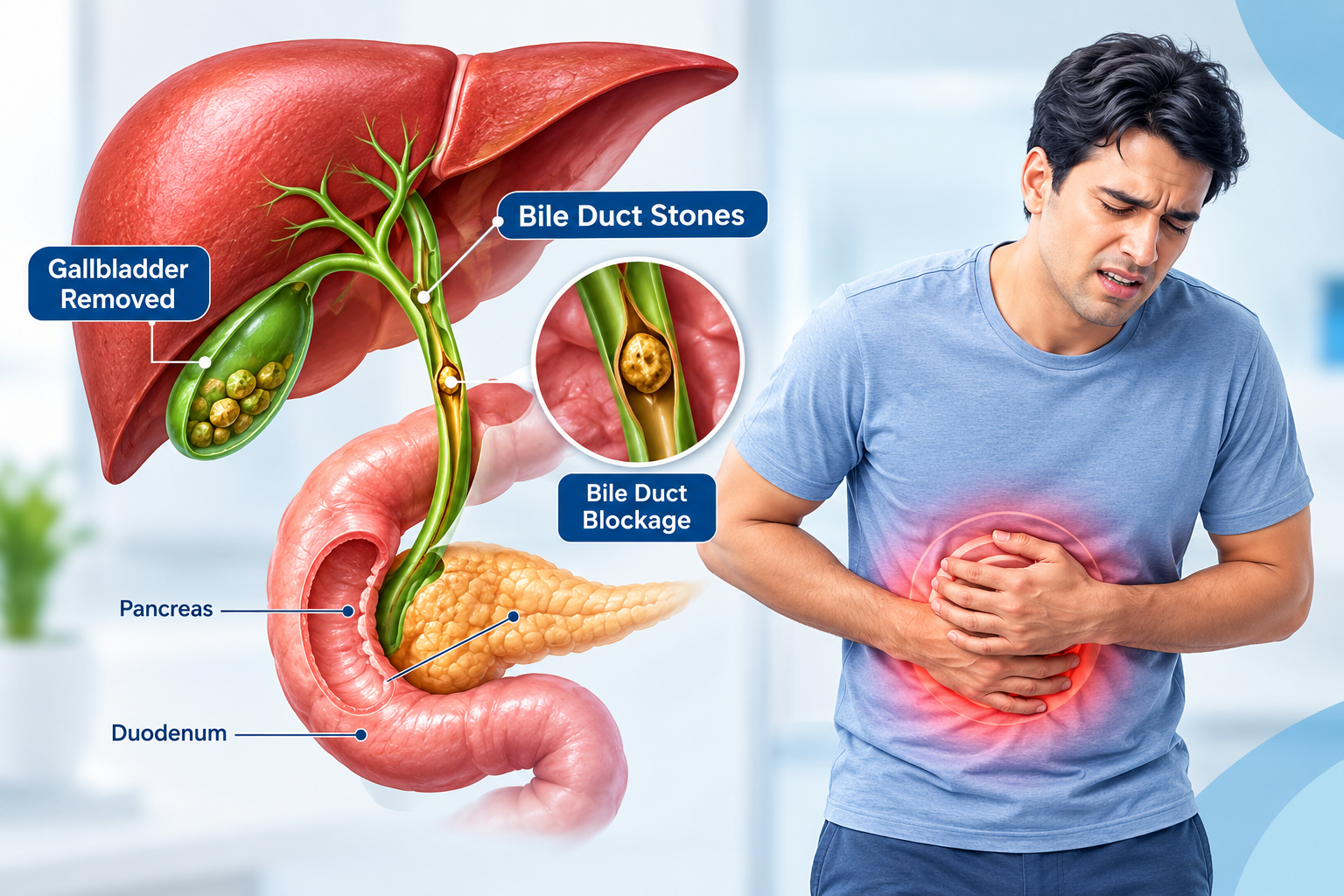
What Are Bile Duct Stones and Strictures?
The common bile duct carries bile from the liver and gallbladder to the intestine. A stone lodged in it causes bile to back up, producing jaundice and pain, and can trigger infection (cholangitis) or pancreatitis. Narrowings (strictures) of the duct can be benign - after surgery or inflammation - or caused by tumours of the duct, pancreas or gallbladder.
Endoscopic retrograde cholangiopancreatography (ERCP) allows the doctor to reach the duct through the mouth and stomach, remove stones, and place stents to keep the duct open. For difficult stones, SpyGlass cholangioscopy gives a direct camera view inside the duct so that stones can be fragmented under vision. Both are performed in our endoscopy suite.
A blocked bile duct often shows up as yellow eyes, dark urine or pain, and it can make you feel quite unwell. The good news is that most blockages caused by stones can be cleared through the endoscope, without an operation.
Some blockages are caused by a narrowing rather than a stone. Many of these are benign, but because a tumour can look similar, the doctor will want to examine the narrowing closely and often take samples before deciding on treatment.
Symptoms of a Blocked Bile Duct
The signs of a blocked bile duct can come on suddenly or build up over days. You may also notice:
- Pain in the upper abdomen, often severe
- Jaundice - yellow eyes, dark urine, pale stools
- Itching
- Fever and shivering when the duct becomes infected
- Nausea and vomiting
- Sometimes silent, found on tests for abnormal liver function
- Pain that comes and goes as a stone moves in the duct
- Feeling unusually tired and losing your appetite
Symptoms vary from person to person. Having one or more of these does not confirm the condition - it means it is worth being checked.
When Is a Blocked Bile Duct an Emergency?
Do not wait for an online appointment if you have any of the following. Call the hospital or go to the nearest emergency department.
- Jaundice with fever and shivering - cholangitis is an emergency
- Jaundice with confusion or low blood pressure
- Severe pain radiating to the back with vomiting
How We Find Stones and Narrowings in the Bile Duct
At your first visit the doctor asks about pain, fever, yellowing and any past gallbladder surgery, and examines you. Blood tests and an ultrasound come first. Further imaging or EUS is chosen to find the stone or examine a narrowing, and ERCP is used when treatment is needed.
What Causes a Bile Duct Blockage?
- Gallstones migrating from the gallbladder
- Stones forming in the duct itself, especially after gallbladder removal or in a dilated duct
- Benign strictures after surgery, pancreatitis or inflammation
- Tumours of the bile duct, pancreas, gallbladder or ampulla
- Parasitic infection in some regions
Most bile duct stones start in the gallbladder and slip down into the duct, which is why the gallbladder is usually removed once the duct is clear. Narrowings have many causes: scarring after an operation, inflammation from pancreatitis, or a tumour of the duct or pancreas. Finding which one it is guides the treatment.
Investigations
- Blood tests
- Liver function tests showing an obstructive pattern, and inflammation markers.What to expect: A routine blood sample. Liver tests show whether the duct is blocked and may be repeated to check progress.
- Ultrasound
- Shows dilated ducts and often the stone.What to expect: A painless scan with gel and a probe on your abdomen. You may be asked not to eat for a few hours before.
- MRCP
- A detailed MRI map of the bile ducts and pancreatic duct without any instrument.What to expect: A type of MRI scan. You lie still in the scanner, which is noisy, and no instrument is passed into the body. Tell the team if you have any metal implants or a pacemaker.
- Endoscopic ultrasound
- Very accurate for small duct stones and for examining strictures.What to expect: Done like an endoscopy, under sedation, with a small ultrasound probe on the tip of the scope. You go home once the sedation wears off.
- ERCP with cholangioscopy
- Diagnosis and treatment in one procedure; SpyGlass allows direct visualisation and targeted biopsies of strictures.What to expect: Done under sedation with monitoring, through the mouth, with no cut. Stones can be removed or samples taken during the same procedure, and your doctor explains the findings afterwards.
Treatment Options for Bile Duct Stones and Blockage
The usual path
- Treat infection urgently.
If the duct is infected, antibiotics are started and the duct is drained promptly, usually by ERCP.
- Clear the duct.
Stones are removed by ERCP, and large or difficult stones are broken up using SpyGlass cholangioscopy.
- Keep the duct open.
A stent can be placed to keep bile flowing, either for a time or longer-term for a narrowing.
- Prevent it happening again.
The gallbladder is usually removed once the duct is clear. Narrowings that cannot be treated through the endoscope may need bile duct surgery.
Endoscopic treatment
- ERCP stone removal
- The duct opening is enlarged and stones are extracted with balloons or baskets. Large stones can be crushed or fragmented with SpyGlass-guided lithotripsy.
- Stenting
- A small tube keeps the duct open and draining - temporarily for infection or stone clearance, or longer-term for strictures and tumours.
- Antibiotics and urgent drainage
- For cholangitis, the duct must be drained promptly, usually by ERCP.
Surgery
- Removal of the gallbladder
- Once the duct is clear, the gallbladder is usually removed to prevent recurrence.
- Surgery
- For strictures or tumours that cannot be managed endoscopically, our surgical team performs bile duct surgery.
The right treatment depends on the cause, how severe it is and your overall health. Your doctor will discuss the options with you before anything is decided.
Frequently Asked Questions about Bile Duct Stones
Is ERCP an operation?
No. It is an endoscopic procedure done under sedation or anaesthesia through the mouth, with no incision. Most patients go home the same day or the next.
What are the risks of ERCP?
The main risks are pancreatitis, bleeding and infection. They are uncommon and the team takes specific precautions; your doctor will discuss them with you beforehand.
Why do I still get stones after my gallbladder was removed?
Stones can form in the duct itself, particularly if it is dilated. ERCP clears them, and some patients need periodic follow-up.
How soon after ERCP should my gallbladder be removed?
Once the duct is clear, removal of the gallbladder is usually advised fairly soon, because stones left in it can slip into the duct again and cause another blockage, infection or pancreatitis. The exact timing depends on your recovery from the ERCP, any infection and your general fitness, and your doctor will decide it with you after assessment.
What should I watch for after going home from ERCP?
Mild discomfort or bloating on the day is common. Severe or increasing abdominal pain, fever or shivering, vomiting, black stools, vomiting blood or return of yellow eyes should be reported to the hospital at once, as they can point to pancreatitis, bleeding or infection. Follow the instructions you are given about diet and medicines, and keep your follow-up appointment.
Can a bile duct stone pass on its own?
Small stones sometimes pass into the intestine without treatment. A stone causing jaundice, infection or pancreatitis, or one still seen on tests, is usually removed by ERCP rather than left to pass.
How do I prepare for ERCP?
You are asked not to eat or drink for a time beforehand; your doctor will tell you how long. Tell the team about blood thinners, diabetes medicines and allergies, and come with someone who can take you home.
Is a narrowing of the bile duct always cancer?
No. Many narrowings are caused by scarring after surgery, pancreatitis or inflammation. Brushings or biopsies taken during ERCP, SpyGlass or EUS help tell a benign narrowing from a tumour.
Why Choose Gujarat Hospital for Bile Duct Stones
How we look after bile duct stones and blockage at our main hospital in Adajan, Surat:
- ERCP in our endoscopy suite, under sedation with monitoring, to remove stones and place stents without an incision.
- SpyGlass cholangioscopy for difficult cases. A camera inside the bile duct lets large stones be broken up under direct view and narrowings be biopsied.
- EUS to look closely at the duct, for small stones and narrowings that other tests do not show clearly.
- Surgeons on the same campus. Gallbladder removal after the duct is cleared, and bile duct surgery when it is needed, are done by our GI surgical team.
The information on this page is for general patient education and does not replace individual medical advice, diagnosis or treatment. Medical Disclaimer