
Endoscopic Ultrasound (EUS) in Surat What to Expect
Endoscopic ultrasound (EUS) combines an endoscope with an ultrasound probe at its tip, giving detailed images of the pancreas, bile duct, and the walls of the food pipe, stomach and rectum from inside the body - and allows a fine needle to take samples from what it sees.
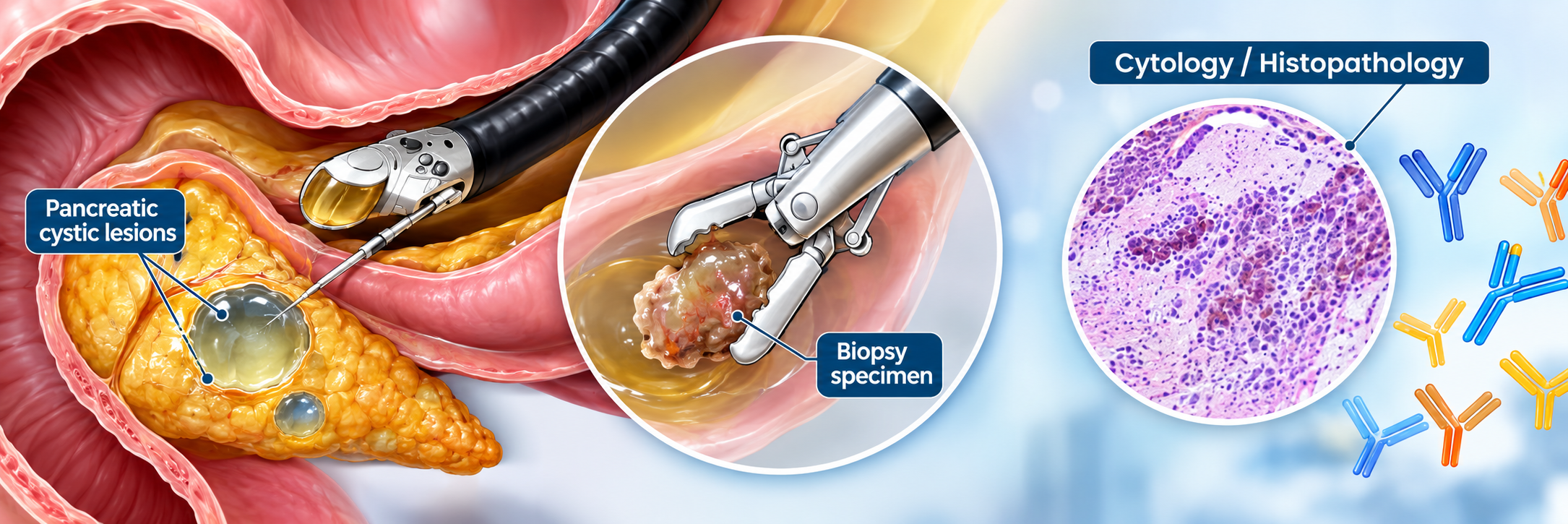
What is Endoscopic Ultrasound (EUS)?
Because the probe sits right next to the organ, EUS shows the pancreas and bile duct in far more detail than a scan from outside. It finds small stones and tumours, stages cancers by showing how deep they go and whether nearby lymph nodes are involved, and characterises pancreatic cysts. When tissue is needed, a needle guided by the ultrasound image takes a sample safely.
EUS is also used for treatment: draining pancreatic fluid collections into the stomach, and blocking the nerves that carry pancreatic pain. Our medical gastroenterologists perform diagnostic and therapeutic EUS under sedation in the endoscopy suite at Adajan.
When is EUS or an EUS-guided Biopsy Needed?
Your doctor may recommend it for:
- Assessing a mass or cyst in the pancreas, with fine-needle sampling See: pancreatic cysts · pancreatic cancer
- Looking for small bile duct stones or the cause of a dilated duct See: bile duct stones and blockage · obstructive jaundice
- Staging cancers of the food pipe, stomach, rectum and pancreas See: cancers of the digestive system
- Examining lumps under the lining of the stomach or food pipe
- Draining pancreatic pseudocysts and collections
- Nerve block for pain in chronic pancreatitis or pancreatic cancer
EUS usually comes after a CT or MRI has shown something that needs a closer look or a sample - it answers the question the scan could not.
Your EUS Visit: Step by Step
Diagnostic EUS is a day visit. Expect two to three hours at the hospital; the procedure itself usually takes thirty to sixty minutes.
- Arrival and check-in
Check-in at the main hospital in Adajan, with your scans.
- Preparation
A small cannula is placed in a vein for sedation (or anaesthesia, if planned), and your pulse, oxygen and blood pressure are monitored from here on. For rectal EUS an enema is given beforehand.
- The procedure
Thirty to sixty minutes in the endoscopy suite (described in the next section).
- Recovery
You rest in the recovery area for an hour or two until the sedation wears off.
- Going home
The doctor tells you what was seen. Someone accompanies you home; biopsy results take a few days and are discussed at follow-up.
What Happens During EUS
Sedation or anaesthesia is given
The echoendoscope is passed through the mouth (or the anus for rectal EUS) to the area of interest
Ultrasound images are obtained through the wall of the gut
If sampling is needed, a fine needle is passed under ultrasound vision into the target and cells or a core of tissue are drawn
For drainage, a stent is placed between the stomach and the collection under the same guidance
The procedure usually takes thirty to sixty minutes
What you will feel - and what you won't. The experience is much the same as an ordinary upper endoscopy: a brief gagging feeling as the scope passes the throat and some fullness from air, nothing more. With sedation most patients are relaxed and remember little. You do not feel the ultrasound, and you do not feel the needle when a sample is taken - the doctor watches it on the screen the whole time.
How to Prepare for EUS
- Blood thinners. Blood thinners are usually stopped before a biopsy, as advised by the team.
- Rectal EUS. For rectal EUS an enema is given beforehand.
These are general points. The written instructions you receive from the hospital for your own procedure take priority - see also Patient Information.
After EUS: Recovery & Biopsy Results
The first hours. Recovery from sedation for an hour or two. Mild sore throat or bloating is common. A light diet the same day unless told otherwise.
The rest of the day. Because sedation is used, you should not drive, operate machinery or sign important documents for the rest of the day, and someone should accompany you home. Report fever, severe abdominal pain or bleeding promptly.
Results. Biopsy results take a few days and are discussed with you at follow-up - at Adajan, or at the OPD nearest you in Varachha, Bharuch, Navsari or Vapi.
Is EUS Safe?
Diagnostic EUS carries the same low risks as upper endoscopy.
Fine-needle sampling adds a small risk of bleeding, infection or pancreatitis; drainage procedures carry their own specific risks which are explained beforehand.
Contact the hospital if you develop fever, severe abdominal pain or bleeding after the procedure.
After a procedure, contact the hospital at once for severe pain, fever, vomiting, bleeding or breathlessness: Emergency 24×7: 90333 62020
Alternatives to EUS
CT and MRI give a wider view and are usually done first; EUS adds detail and tissue.
Biopsy through the skin under CT guidance is an alternative for some lesions.
ERCP is the alternative for duct problems that need treatment.
Why Choose Gujarat Hospital for EUS
EUS is where diagnosis and treatment of the pancreas and bile duct meet, and it is only as good as the team reading the pictures and taking the sample. At Gujarat Gastro & Vascular Hospital, Adajan, Surat:
- Diagnostic and therapeutic EUS by consultant medical gastroenterologists. Fine-needle sampling, drainage of pancreatic collections and nerve blocks are all done here, under sedation with full monitoring in the endoscopy suite.
- The sample goes to the doctor who will treat you. The same gastroenterologists who manage your pancreas, bile duct or cancer plan the EUS and act on the result - so the biopsy is taken from exactly what matters for your treatment.
- ERCP and SpyGlass in the same unit. If EUS shows a duct problem that needs treating, ERCP - with SpyGlass for difficult stones and strictures - is available from the same team, often without a second admission.
Frequently Asked Questions about EUS
Is EUS the same as an ordinary endoscopy?
It uses a similar scope with an ultrasound probe added, so the experience is much the same, but it gives information an ordinary endoscopy cannot.
Will I be asleep?
Diagnostic EUS is usually done under sedation - you are drowsy and relaxed, breathing on your own, and remember little. For longer therapeutic procedures anaesthesia may be planned instead; your doctor tells you beforehand. You are monitored throughout.
Why do I need EUS if I already had a CT scan?
CT may show a lesion but not what it is. EUS looks more closely and can take a sample, which is often what decides treatment.
How long until I get the biopsy result?
The doctor tells you what was seen on the day. The pathology report on the sample takes a few days, and is explained at your follow-up along with what it means for treatment.
Is the needle biopsy safe?
Yes, in experienced hands. The needle is watched on ultrasound throughout and avoids blood vessels.
What is the difference between EUS and ERCP?
EUS looks at the pancreas, bile duct and gut wall from inside and takes samples, but does not enter the ducts. ERCP passes a wire and instruments into the bile or pancreatic duct to remove stones, place stents or open narrowings. Often EUS is done first to confirm what is wrong, and ERCP follows if treatment of the duct is needed.
Can I go back to work the same day?
Because of the sedation you should not drive, operate machinery or sign important documents for the rest of the day, and someone should take you home. Most people are back to normal the next day; after a drainage procedure your doctor will advise.
What happens if the EUS biopsy does not give a clear answer?
Occasionally the sample contains too few cells or the result is uncertain. The doctor may then repeat the EUS with a different needle, arrange a biopsy through the skin under CT guidance, or, for a lesion that looks low-risk, monitor it with scans at intervals. The decision is made after reviewing the images and the pathology report together.
The information on this page is for general patient education and does not replace individual medical advice, diagnosis or treatment. Medical Disclaimer