
Colonoscopy in Surat What to Expect
A colonoscopy test examines the whole large bowel with a flexible camera passed through the anus, after the bowel has been cleaned with a preparation drink. Polyps can be removed during the test, which is why it prevents as well as detects bowel cancer.
What is a Colonoscopy?
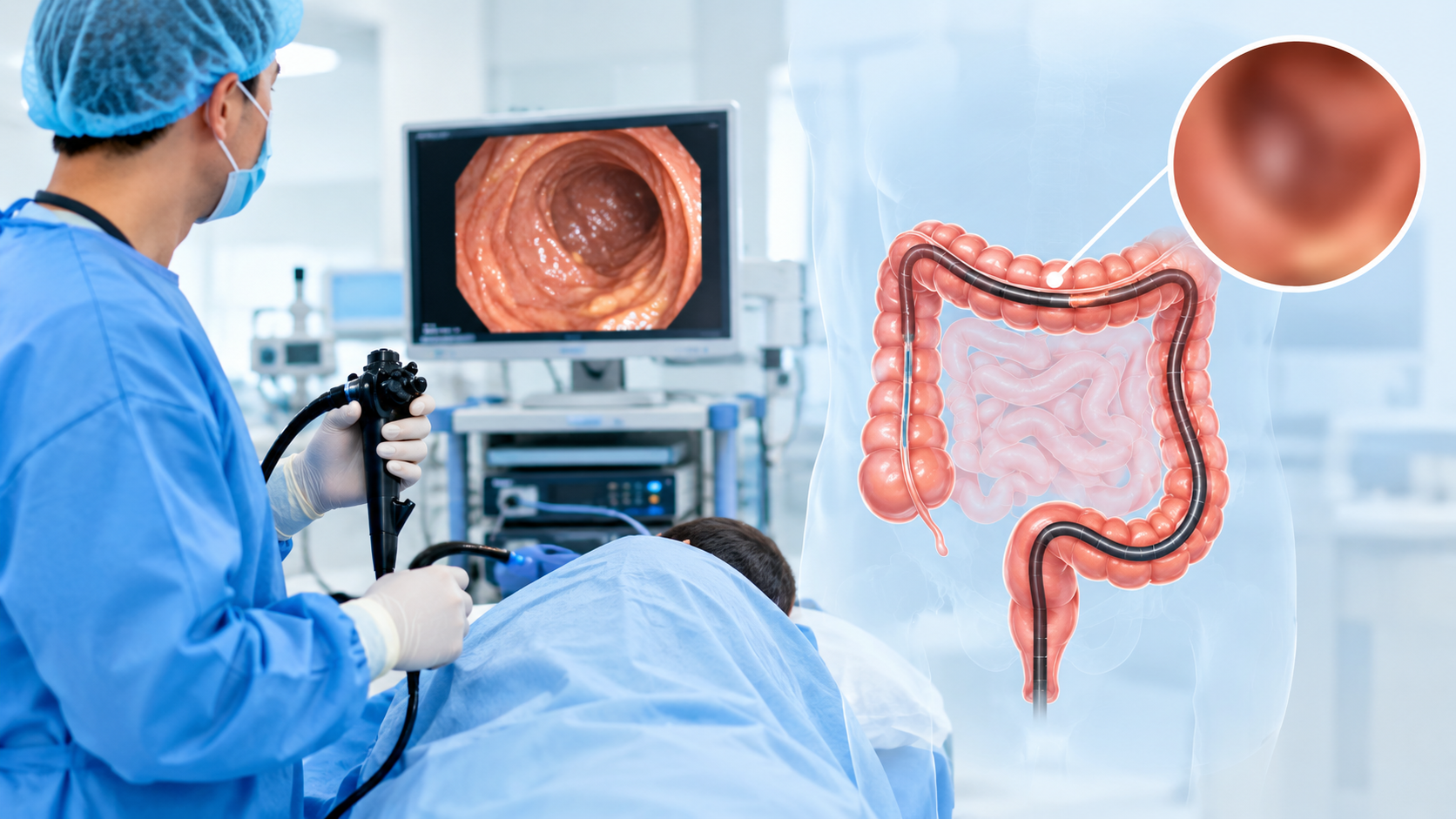
Colonoscopy is the most complete way to examine the large bowel. A flexible camera is passed through the anus and guided around the whole colon to the point where the small bowel joins it, so the doctor sees the lining directly on a screen.
The large bowel must be empty for the lining to be seen, so the preparation the day before is the most important part of the test. The colonoscopy itself is done under sedation, takes twenty to forty minutes, and lets the doctor see the rectum and colon in detail, take biopsies and remove polyps - which is why it prevents as well as detects bowel cancer.
Our gastroenterologists perform diagnostic and therapeutic colonoscopy in the endoscopy suite at Adajan, including removal of large polyps (EMR/ESD) and assessment and treatment of inflammatory bowel disease.
When is a Colonoscopy Recommended?
Your doctor may recommend it for:
- Blood in the stool or unexplained anaemia See: black stool or blood in the stool
- A change in bowel habit lasting more than a few weeks, especially after the age of 45 See: constipation, diarrhoea and IBS
- Diagnosis and monitoring of ulcerative colitis and Crohn's disease See: ulcerative colitis and Crohn's disease
- Screening for bowel cancer, and surveillance after polyps or a family history
- Investigation of chronic diarrhoea, weight loss or abdominal pain
- Removal of polyps found on imaging See: colon and rectal conditions
A change in bowel habit or blood in the stool should always be checked - a colonoscopy either finds the cause or gives real reassurance.
Your Colonoscopy Visit: Step by Step
A colonoscopy is a day visit, but it starts the day before with the bowel preparation. Expect two to three hours at the hospital; the examination itself takes twenty to forty minutes.
- The day before
You follow the low-residue diet and take the prescribed cleansing drink as instructed - this is what makes the test accurate.
- Arrival and check-in
Check-in at the main hospital in Adajan; the team checks that your bowel preparation is complete.
- Preparation
A small cannula is placed in a vein for sedation, and your pulse, oxygen and blood pressure are monitored from here on.
- The procedure
Twenty to forty minutes in the endoscopy suite (described in the next section).
- Recovery and going home
You rest until the sedation wears off, usually within an hour. The doctor tells you what was seen, and someone accompanies you home; biopsy and polyp results follow at your follow-up.
What Happens During a Colonoscopy
Bowel preparation: a low-residue diet and a prescribed cleansing drink taken the day before and/or the morning of the test, as instructed
Sedation is given through a small cannula
You lie on your left side; the colonoscope is passed gently around the bowel while air or water opens it
The lining is examined carefully as the scope is withdrawn
Polyps are removed with a snare and biopsies taken as needed
The test takes twenty to forty minutes
What you will feel - and what you won't. The test is uncomfortable rather than painful. With sedation most people feel little or nothing beyond some pressure, a sense of wind as air or water opens the bowel, and brief cramping as the scope passes the bends. Removing polyps and taking biopsies is painless - the bowel lining does not feel them. Most patients are drowsy and remember little of the test.
How to Prepare for Your Colonoscopy
- The bowel preparation is the test. Follow the bowel-preparation instructions exactly - an incomplete preparation may mean the test has to be repeated.
- Medicines. Blood thinners and some diabetes medicines need adjusting beforehand; the team will tell you how.
- Someone to take you home. Arrange for someone to take you home - because of the sedation you cannot drive yourself.
These are general points. The written instructions you receive from the hospital for your own procedure take priority - see also Patient Information.
After Your Colonoscopy: Recovery & Results
The first hour. Recovery from sedation takes about an hour. The doctor tells you what was seen straight away.
The rest of the day. Bloating and passing wind are normal for a few hours; walking helps. You can eat normally afterwards unless told otherwise. Because sedation is used, you should not drive, operate machinery or sign important documents for the rest of the day, and someone should accompany you home.
If a polyp was removed. A small amount of blood after polyp removal can occur; heavy bleeding, severe pain or fever should be reported immediately. The pathology report follows at your follow-up and decides when the next colonoscopy is due.
Is Colonoscopy Safe?
Colonoscopy is safe. Bloating and mild cramps are common and brief.
Bleeding after polyp removal and, rarely, a perforation of the bowel wall are the main serious risks; they are uncommon and are explained before consent.
Sedation carries a small risk, especially for people with heart or lung disease, which is assessed beforehand.
Contact the hospital if you develop heavy bleeding, severe abdominal pain or fever after the procedure.
After a procedure, contact the hospital at once for severe pain, fever, vomiting, bleeding or breathlessness: Emergency 24×7: 90333 62020
Alternatives to Colonoscopy
CT colonography (a CT scan of the bowel) can show large polyps but cannot remove them or take biopsies.
Stool tests for hidden blood are used for screening in some settings and lead to colonoscopy if positive.
Flexible sigmoidoscopy examines only the lower part of the bowel.
Why Choose Gujarat Hospital for Colonoscopy
Colonoscopy prevents bowel cancer only if it is done thoroughly and whatever is found can be dealt with on the spot. At Gujarat Gastro & Vascular Hospital, Adajan, Surat:
- A dedicated endoscopy suite with sedation and monitoring. Your pulse, oxygen and blood pressure are watched throughout, and you recover in a proper recovery area until you are fully awake.
- Polyps removed in the same sitting. Small polyps are removed with a snare as they are found; large flat polyps can be removed endoscopically (EMR/ESD) by the same team rather than referred on - so you rarely need a second procedure.
- Inflammatory bowel disease assessed and treated by the same doctors. Our consultant medical gastroenterologists diagnose and manage ulcerative colitis and Crohn's disease, so the colonoscopy findings go straight into your treatment plan.
Frequently Asked Questions about Colonoscopy
Is the preparation unpleasant?
It is the least popular part - you will spend the evening near a toilet - but it is essential. Newer preparations are smaller in volume, and clear instructions make it manageable.
Will I be asleep?
You are given sedation, not a general anaesthetic. Most patients are drowsy and relaxed, many remember nothing of the test, and you are breathing on your own throughout. The team monitors you the whole time.
Will I feel the colonoscopy?
With sedation most people feel little or nothing beyond some pressure or wind.
Can I drink water during the bowel preparation?
Clear liquids are usually allowed - and encouraged - until the time stated in your written instructions, because the preparation drink and the fasting can leave you dehydrated. Your instructions give the exact cut-off times for liquids and for food; please follow them.
Why remove polyps if they are not cancer?
Because some polyps turn into cancer over years. Removing them at colonoscopy is how the test prevents bowel cancer.
How should I manage my diabetes medicines on the day of bowel preparation?
Because you will be on clear liquids and then fasting, your usual dose of insulin or tablets can cause low blood sugar. The team will give you written instructions on which medicines to reduce or omit and when. Check your sugar more often during the preparation, keep a source of sugar-containing clear liquid nearby, and tell the endoscopy staff about your diabetes on arrival.
Can I go back to work the same day?
Because of the sedation you should not drive, operate machinery or sign important documents for the rest of the day, and someone should take you home. Most people are back to normal the next day; if polyps were removed, your doctor will tell you if anything more is needed.
How often should a colonoscopy be repeated?
It depends on what is found. After a normal test in someone at average risk, a repeat is not needed for many years. If polyps were removed, or there is inflammatory bowel disease or a strong family history, surveillance is repeated at shorter intervals. Your doctor will set the interval once the biopsy results are available.
The information on this page is for general patient education and does not replace individual medical advice, diagnosis or treatment. Medical Disclaimer