
Colon and Rectal Conditions in Surat What to Expect
The colon and rectum can be affected by polyps, diverticular disease, inflammation, bleeding, obstruction and cancer. Colonoscopy diagnoses most of these, and our colorectal surgeon treats those that need an operation - increasingly with keyhole or robotic surgery.
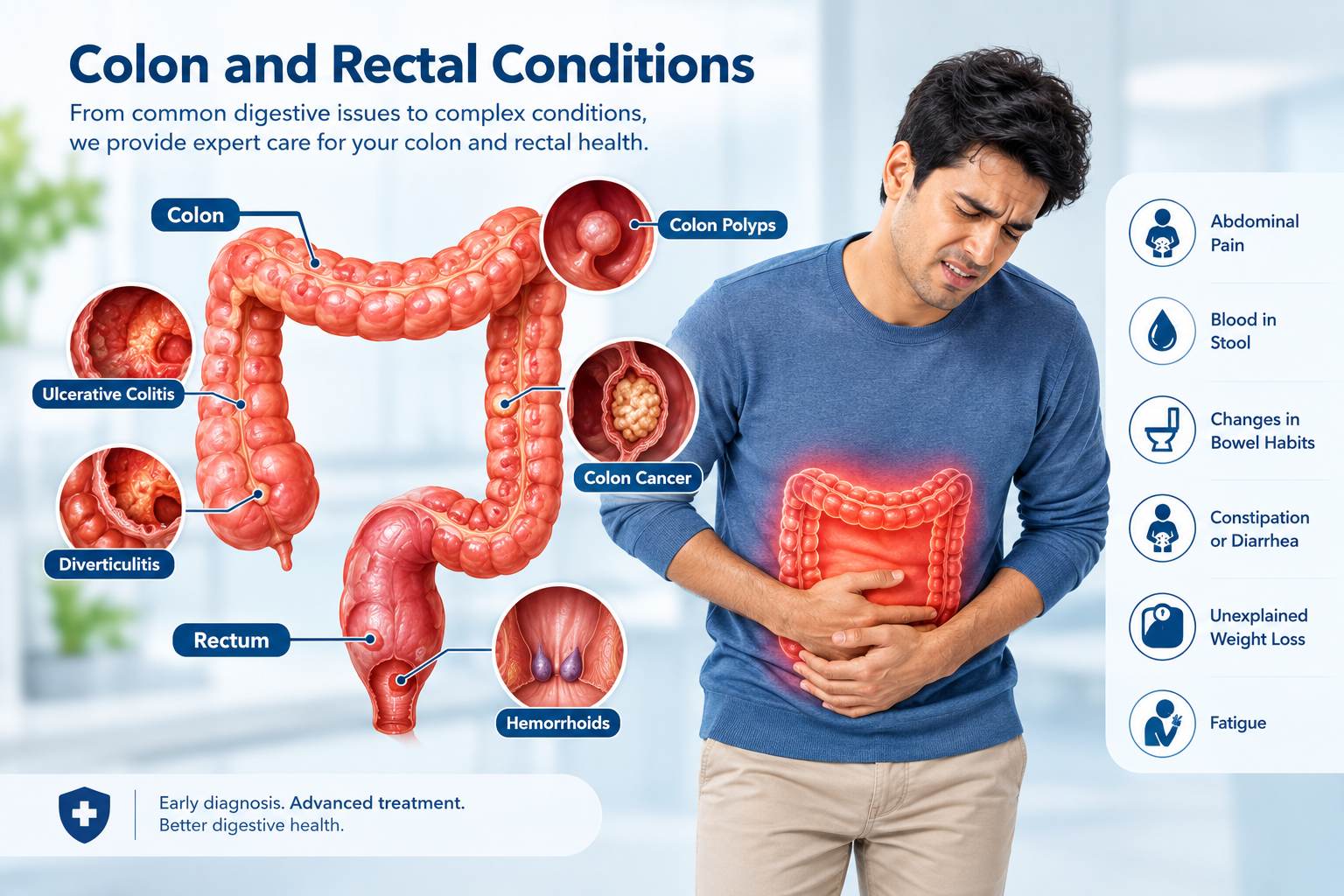
What Are Colon and Rectal Conditions?
Polyps are small growths on the bowel lining; most are harmless, but some slowly turn into cancer, which is why they are removed when found at colonoscopy. Diverticular disease - small pouches in the bowel wall - is common with age and usually harmless, but pouches can become inflamed (diverticulitis) or bleed. Other conditions include rectal prolapse, volvulus, and inflammatory bowel disease.
Colorectal surgery is planned with the medical gastroenterologists who diagnose and follow these patients. Where an operation is needed, the laparoscopic or robotic approach is used whenever it is safe, giving faster recovery.
Many colon and rectal conditions are found because of a change in bowel habit, bleeding or a screening colonoscopy. Most turn out to be common and treatable - polyps, diverticular disease or inflammation - and many need no operation at all.
When surgery is advised, the gastroenterologist and colorectal surgeon look at your results together. The aim is to choose the simplest effective treatment and, when an operation is needed, to use keyhole or robotic surgery wherever it is safe.
Symptoms of Colon and Rectal Problems
Colon and rectal problems can cause a range of symptoms. You may also notice:
- A change in bowel habit lasting more than a few weeks
- Blood in the stool
- Abdominal pain, cramping or bloating
- A feeling of incomplete emptying, or a lump at the anus
- Unexplained weight loss or anaemia
- Fever with lower abdominal pain (diverticulitis)
- Narrower stools than usual, or mucus in the stool
- Tiredness or breathlessness from slow, hidden blood loss
Symptoms vary from person to person. Having one or more of these does not confirm the condition - it means it is worth being checked.
When Should You See a Doctor Urgently for a Bowel Problem?
Do not wait for an online appointment if you have any of the following. Call the hospital or go to the nearest emergency department.
- Severe abdominal pain with swelling and vomiting - possible obstruction
- Heavy rectal bleeding
- High fever with abdominal pain and tenderness
- A prolapsed bowel that cannot be pushed back or becomes painful
How We Diagnose Colon and Rectal Conditions
At your consultation the doctor asks about your bowel habit, bleeding, weight and family history, and examines you. Blood and stool tests are often done next, and colonoscopy is the main test for most conditions. Scans are used for problems outside the bowel lining.
What Causes Colon and Rectal Conditions?
- Polyps - related to age, diet, family history and some inherited syndromes
- Diverticular disease - low-fibre diet and age
- Inflammatory bowel disease
- Infection
- Weakness of the pelvic floor (prolapse)
- Previous surgery or twisting of the bowel (obstruction, volvulus)
Age is the biggest single factor for polyps and diverticular disease, and a family history of bowel cancer or polyps raises the risk of polyps. A diet low in fibre and long-standing constipation also play a part. Some conditions, such as volvulus or prolapse, relate more to the shape of the bowel and the strength of the pelvic floor.
Investigations
- Colonoscopy
- The key test; polyps are removed and samples taken during the same procedure.What to expect: Before the test, you drink a bowel preparation to clear the bowel; you are given written instructions. The test is done under sedation, and polyps can be removed during it. You go home the same day.
- CT scan
- For diverticulitis, obstruction, and staging of any tumour.What to expect: You lie on a table that moves through a ring-shaped scanner, sometimes after a dye injection or drink. It is quick and painless.
- Blood and stool tests
- Anaemia, inflammation markers, infection and faecal occult blood.What to expect: A routine blood sample and a stool sample collected at home in a container you are given.
- MRI of the pelvis and endoanal ultrasound
- For rectal tumours and pelvic-floor problems.What to expect: For the MRI you lie still in the scanner; it is painless but noisy. Endoanal ultrasound uses a small probe placed just inside the anus for a few minutes; it is mildly uncomfortable but not painful.
Treatment Options for Colon and Rectal Conditions
The usual path
- Diet and medicines.
Fibre, fluids and medicines manage many conditions, including diverticular disease and mild inflammation.
- Colonoscopy and polyp removal.
Polyps are removed during colonoscopy, and larger flat lesions with EMR or ESD, without an operation.
- Treating complications.
Diverticulitis is treated with antibiotics, and an abscess may be drained before any decision on surgery.
- Surgery when it is needed.
Prolapse, obstruction, repeated diverticulitis and tumours are treated with keyhole, robotic or open surgery, discussed with you in advance.
Medicines & lifestyle
- Treatment of diverticulitis
- Antibiotics and diet for mild attacks; drainage or surgery for abscess, perforation or repeated attacks.
Endoscopic treatment
- Endoscopic removal of polyps
- Polypectomy and, for larger flat lesions, EMR or ESD through the colonoscope.
Surgery
- Surgery for prolapse and obstruction
- Repair of rectal prolapse and relief of obstruction, usually laparoscopically.
- Cancer surgery
- Removal of the affected segment with its lymph nodes, laparoscopically or robotically where suitable; see the page on digestive cancers.
Other care
- Surveillance
- Follow-up colonoscopy at intervals set by what was found.
The right treatment depends on the cause, how severe it is and your overall health. Your doctor will discuss the options with you before anything is decided.
Frequently Asked Questions about Colon and Rectal Conditions
Do I need a colonoscopy if I have no symptoms?
Screening colonoscopy is recommended from the age of 45-50, or earlier with a family history of bowel cancer or polyps, because polyps can be removed before they turn into cancer.
Is diverticulitis serious?
Most attacks are mild and settle with antibiotics. Complicated or recurrent attacks may need surgery, which is discussed after the acute episode.
What is bowel preparation?
The cleansing drink taken before colonoscopy so that the lining can be seen clearly. Your doctor will give exact instructions.
My polyps were removed at colonoscopy - when do I need the next one?
That depends on how many polyps there were, their size and what the pathologist found in them. Small, low-risk polyps may need a repeat colonoscopy only after several years, while larger or multiple polyps with abnormal cells are checked sooner. Your gastroenterologist will set the interval when the biopsy report is back, and it is important to keep to it.
Does a high-fibre diet help diverticular disease?
Yes, for everyday management. Fibre from vegetables, fruit, whole grains and pulses, with plenty of water, keeps stools soft and reduces pressure in the bowel. During an acute attack of diverticulitis, however, a low-residue or liquid diet is advised until the inflammation settles. Older advice to avoid seeds and nuts is no longer supported.
Should I see a gastroenterologist or a colorectal surgeon?
Either is a good place to start. The gastroenterologist usually does the colonoscopy and treats medical conditions, and the colorectal surgeon sees you if an operation may help. Both work at the same hospital and share your results.
Will I need a stoma (bag) after bowel surgery?
Most bowel operations do not need one. Sometimes a stoma is made for a while to protect a join in the bowel while it heals, and it is usually closed later. Your surgeon will tell you before the operation whether it is likely.
How is rectal prolapse treated?
Mild prolapse may be helped by avoiding straining and treating constipation. A full prolapse usually needs an operation, done either through the abdomen, often by keyhole surgery, or from below. The surgeon recommends the approach that suits your age and health.
Why Choose Gujarat Hospital for Colon and Rectal Conditions
How we look after colon and rectal conditions at our main hospital in Adajan, Surat:
- Colonoscopy with polyp removal in the same sitting, in the hospital's endoscopy suite, with ESD and EMR for larger flat polyps.
- Physician and surgeon working together. Our colorectal surgeon plans treatment with the medical gastroenterologists, including one with special interest in IBD and luminal GI disorders.
- Keyhole and robotic colorectal surgery where it is safe, and open surgery when that is the safer choice.
The information on this page is for general patient education and does not replace individual medical advice, diagnosis or treatment. Medical Disclaimer